Industrial Flood Restoration in Malaysia: How to Save Equipment After Water Damage
Every year, Selangor floods. So does Johor. So does Penang. Across the Strait, Sumatra and Java are seeing the heaviest monsoons in two decades. For factory owners, laboratory managers and port operators across Malaysia, Singapore and Indonesia, the question stopped being if your facility will see water inundation. It’s how fast you can get back to operations when water hits your equipment.
We’ve spent thirty years inside flooded facilities. The pattern is identical every time. The damage you can see is not the damage that kills the business. What kills the business is the time lost between the incident and the first decision.
This article is the field guide we wish every business owner, plant manager, broker, insurer and loss adjuster had on the first morning after the water recedes. It covers what flood water actually does to industrial and sensitive equipment, when restoration is a faster option, the IICRC protocols that decide success or failure, and the real case data from across Malaysia, Singapore and Indonesia.

What is industrial flood restoration?
Industrial flood restoration is the engineering process of recovering machines, electronics and equipment after exposure to floodwater, typically through decontamination, controlled dehumidification, component-level testing and selective part replacement, in line with IICRC S500 international standards. Done within the right window, it returns equipment to pre-loss condition at a fraction of the cost of replacement.
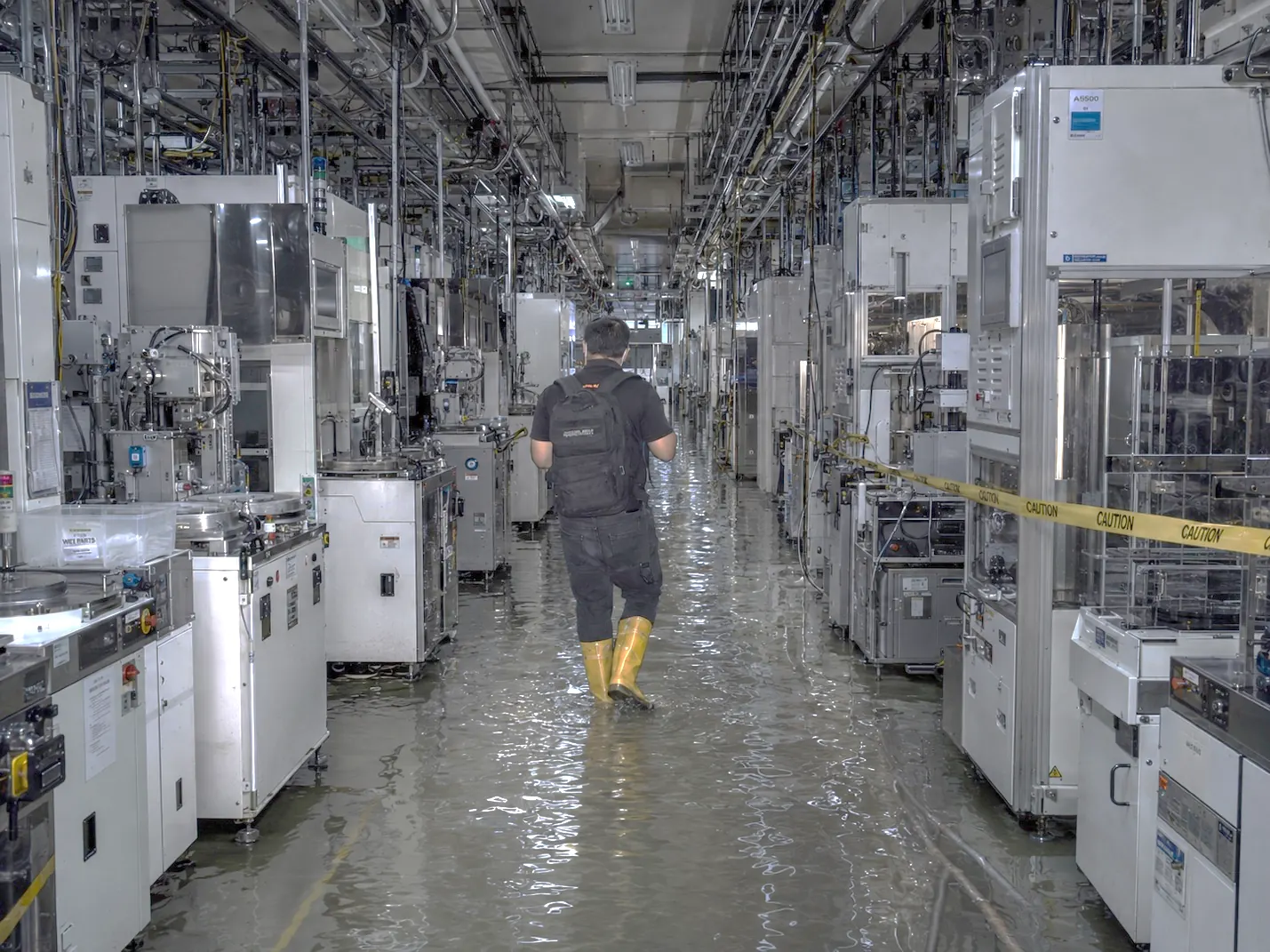
Restoration is not the same as cleaning. Cleaning removes surface dirt. Restoration removes the corrosive contaminants left behind by floodwater after the visible water is gone — the very contaminants that cause equipment failure.
A typical industrial flood restoration project follows seven defined steps:
Each step is documented for insurance purposes and signed off by IICRC-certified technicians.
Restoration is most effective in the first 72 hours after water exposure. After that, corrosion progresses rapidly on circuit boards, motor windings, copper pipework and brass fittings, and the restoration window narrows.
Why floodwater destroys industrial equipment — even after the water is gone
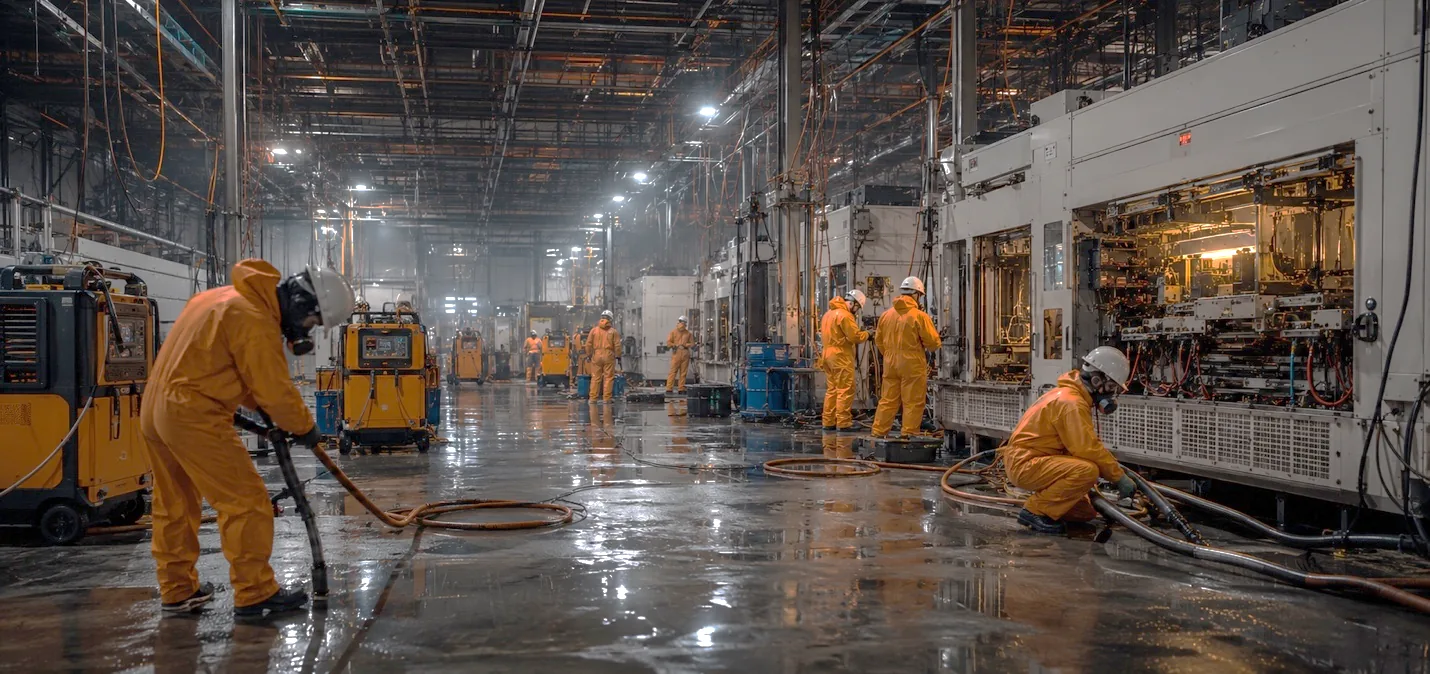
Pure water does not damage powered-off equipment. The problem is what’s dissolved in the floodwater — salts, silts, sewage, organic matter, agricultural runoff. As the water evaporates, these contaminants stay behind on every metallic surface and connector. Combined with oxygen, these contaminants left behind cause corrosion that progresses for weeks after the water has gone.
Flood water in Southeast Asia almost always falls under what IICRC S500 calls Category 3, or black water. It carries pathogens, heavy metals, hydrocarbons from flooded roads, and sewage from overwhelmed drainage systems. This is the worst category of water exposure an industrial facility can experience.
On the inside of a flooded PLC cabinet or a motor winding, here is what happens in stages:
Minutes after water enters:
Moisture penetrates unsealed assemblies and is absorbed by hygroscopic materials such as paper insulation, paint and resin coatings. Solder joints and pin headers start to oxidise.
Hours after:
Surface oxidation appears on copper traces, motor windings and connectors. Sensitive electronics that are still energised may short out catastrophically.
Days after:
Corrosion eats motherboards, servo drives, laser controllers, signal conditioners and UPS units. Replacement becomes the only option for components that could have been restored a day earlier.
Restoration or replacement: how to decide
For most industrial equipment, restoration costs 4 to 40 times less than replacement and finishes in one-quarter to one-tenth of the time. Replacement is only the better option when equipment is more than 70% damaged, structurally compromised, or already at end-of-life.
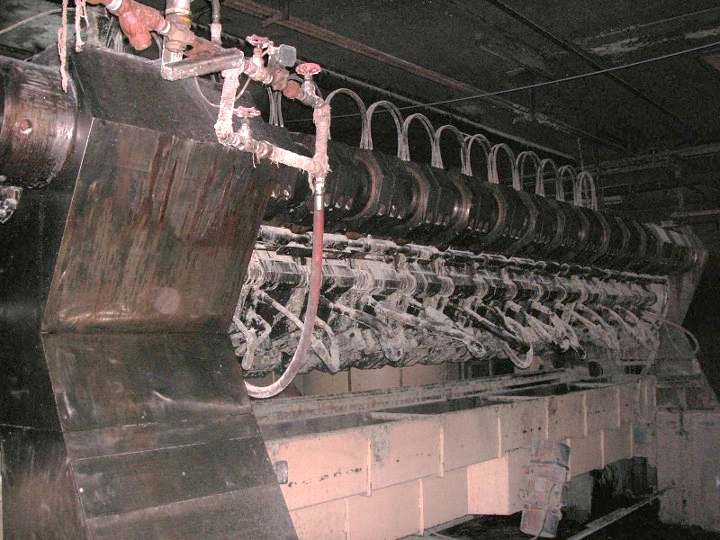
Five real cases from our recent work show the pattern.
1. A flooded semiconductor manufacturing facility in Shah Alam:
- over USD 20 million in equipment value at risk, restored in 28 days for USD 580,000.
2. A pipe-burst nano laboratory in Malaysia:
- 13 instruments at USD 8 million replacement value, restored for USD 200,000 in one month.
3. A fire-damaged quay crane at a Malaysian container port:
- USD 1 million replacement, USD 250,000 restoration, four months of port productivity recovered.
4. A heavy industrial conveyor:
- USD 1 million replacement, USD 250,000 restoration.
5. A custom Swedish-built oil tank cleaning system contaminated with seawater in transit:
- USD 12 million replacement value, USD 1.5 million restoration.
Across those five cases, approximately USD 33 million in replacement cost was avoided. Roughly 30 months of cumulative downtime was avoided.
The decision framework is straightforward.
Ask: what is the OEM lead time for replacement? What is the financial impact of being offline for that period? What is the restoration cost? If restoration is less than 50% of replacement and the equipment is structurally intact, restoration is almost always the right call.
The 72-hour rule: what to do in the first three days after a flood
In the first 72 hours after floodwater enters a facility, four actions decide the outcome. Power everything down. Document everything photographically. Engage an IICRC-certified restorer immediately, in parallel with the loss adjuster, not after. And start drying — even with basic fans — before any restoration team arrives.
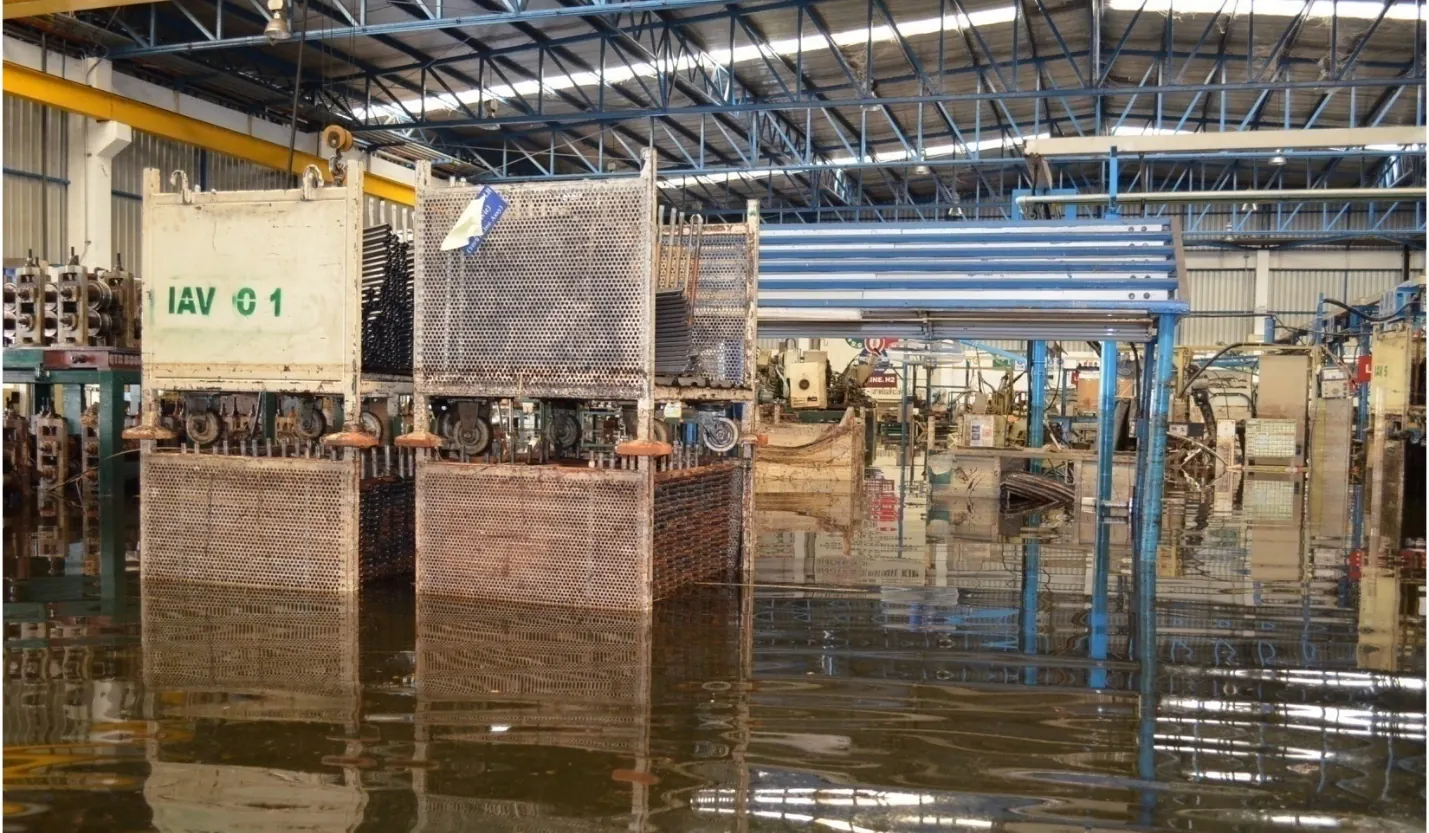
First 24 hours
When safe, de-energise affected equipment immediately, including UPS backup power. Begin water extraction with submersible pumps and wet vacuums. Once the bulk of the water is out, open the facility to air movement. Take photographs and videos of every affected machine, control cabinet and panel. The documentation matters more than most people realise — it is the basis of every insurance conversation that follows.
Hours 24 to 48
Engage your specialist restoration provider. Ask them to begin damage assessment in parallel with your loss adjuster, not in sequence. The standard sequence — loss adjuster reports first, then restorer quotes — costs you days. Days that translate directly into corrosion progression.
Hours 48 to 72
Begin stabilisation. Industrial dehumidifiers should be in place, bringing relative humidity below 40%. Any unpainted metal surfaces should be coated with a rust inhibitor as an emergency measure. Critical electronics should be moved to a low-humidity environment if at all possible.
Once a professional restoration team is on site within 72 hours of the incident, restoration outcomes improve dramatically. We have restored semiconductor plants because the client called within 24 hours. On the other hand, we have watched equipment become unrecoverable because the call came on day seven.
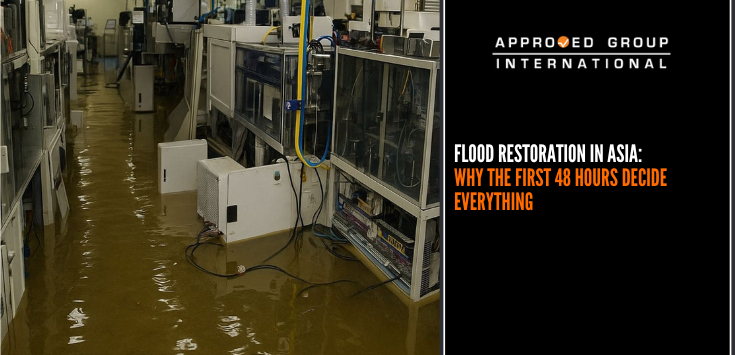
Our earlier guide sets out the immediate response steps in the first 48 hours.
IICRC standards: why they matter for insurance claims
IICRC S500 is the global standard for water damage restoration. It defines water categories, drying classes, dehumidification requirements and documentation protocols. Globally, insurers recognise IICRC certification as the benchmark for restoration work, and IICRC documentation is legally defensible in insurance disputes.
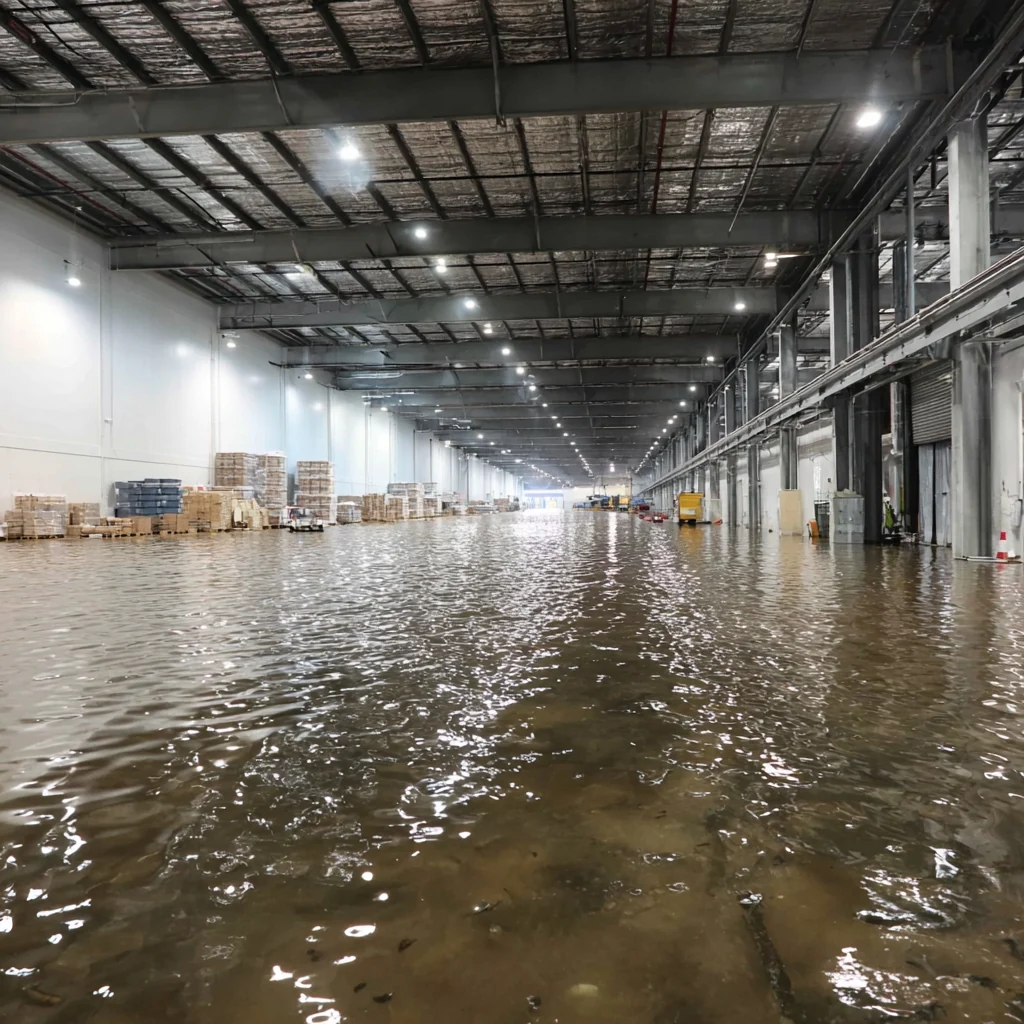
S500 categorises water exposure into three classes.
Category 1 is clean water from broken supply lines.
Category 2, or grey water, includes discharge from washing machines or sprinkler systems — unsanitary but not pathogenic.
Category 3, or black water, includes all forms of flooding — pathogenic, contaminated, and treated under the strictest protocols.
When you work with an IICRC-certified restorer, you get more than a methodology. You get a documentation chain that insurers across the region treat as authoritative. Restoration reports built to IICRC standards are recognised by most major regional (re)insurers without further qualification.
Approved Group International (AGI)’s technicians are IICRC-certified across Water Damage Restoration, Fire and Smoke Restoration, Odor Technician and Mould Remediation. Our reports conform to ASTM E620-18 Standard Practice for Reporting Opinions of Technical Experts.
Common industrial flood damage scenarios across Malaysia, Singapore and Indonesia
The five most common industrial flood scenarios we see across Asia are: semiconductor and electronics manufacturing, plastics and packaging plants, laboratory and clean-room facilities, food and beverage production lines, and port and logistics infrastructure. Each one has a distinct restoration playbook.
Semiconductor and electronics manufacturing
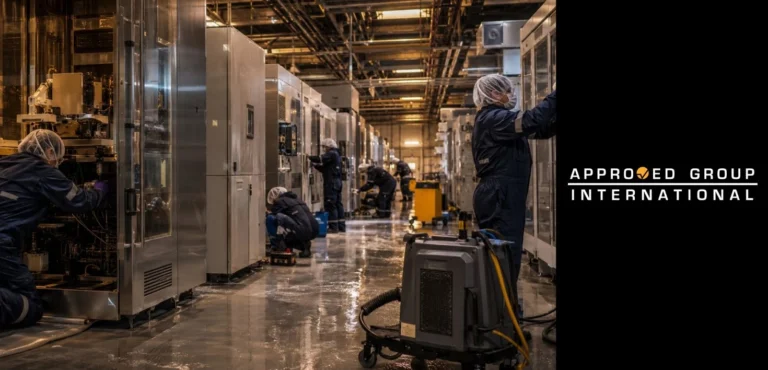
Precision machines with sensitive PLCs, servo drives, laser markers and inspection systems. The restoration playbook is large-scale decentralized — multiple teams running in parallel, line-by-line restart, OEM-witnessed energization. The December 2021 floods in Shah Alam (Malaysia) are the textbook case.
Plastics and packaging plants
Blow film machines, extruders, granulators, slitters, recycling lines. Heavy on inverters, motors, and electrical control panels. Part replacement on the worst-affected machines, decontamination on the rest. The Lampung (Indonesia) floods of January 2025 produced multiple cases at this scale.
Laboratory and clean-room facilities
High-individual-value instruments — confocal microscopes, SEMs, Raman spectrometers, FTIR. Restoration is instrument-by-instrument, with AGI witness vendors’ energisation. Most of these instruments are recoverable.
Food and beverage production lines
Filling machines, conveyors, packaging equipment, refrigeration. Hygiene protocols layer on top of restoration protocols — IICRC S540 trauma and pathogen contamination standards apply alongside S500.
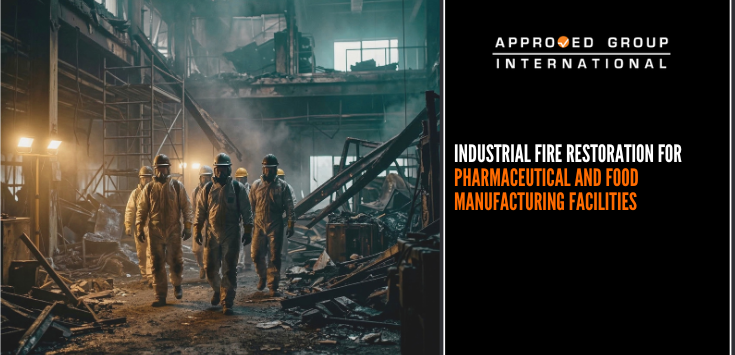
We cover the same problem after a fire in our article on industrial fire restoration for pharmaceutical and food manufacturing facilities.
Port and logistics infrastructure
Quay cranes, gantry cranes, container handling equipment. The fire scenarios at ports are particularly tough because of the combination of soot, salt-air corrosion, and the operational pressure to keep berths productive.
FAQ
How long does industrial flood restoration take?
Most industrial flood restoration projects complete in 2–12 weeks, compared to 6–18 months for full replacement. The exact timeline depends on equipment complexity, water category, time-to-response, and parts availability for components that fail testing.
What’s the difference between cleaning and restoration?
Cleaning removes visible surface contamination. Restoration goes further by addressing residual corrosive contaminants that may remain after floodwater evaporates, drying affected components to defined humidity targets, and verifying their functional integrity through appropriate testing and controlled energisation. Hence, restoration is not merely cleaning — it is time-sensitive technical mitigation supported by engineering assessment, documentation, and verification.
Can I do flood restoration myself?
Yes, for the first 24 hours — water extraction, drying, basic protection and stabilization — and you should as soon as possible when it is safe to do so. After that, restoring industrial equipment requires IICRC-certified expertise, specialised decontamination agents, temperature-controlled drying chambers, and the engineering judgment to know which components are recoverable. Self-restoration of complex machines beyond the stabilisation phase often may not yield the desired results.
How do I find a qualified flood restorer in Malaysia, Singapore or
Indonesia?
Look for IICRC certification — specifically Water Damage Restoration (WRT), Fire and Smoke Restoration (FST) where relevant. Ask for recent case references with named reinsurers and insurers. Ask whether the restorer can produce reports recognised by your specific insurance carrier. Approved Group International operates across the ASEAN region with full IICRC certification across all four major restoration disciplines.