The Vehicle Identification Number (hereinafter referred to as VIN) is the identifying code for a specific vehicle comprising of 17 alphanumeric characters…
·5 min read
The Vehicle Identification Number (hereinafter referred to as VIN) is the identifying code for a specific vehicle comprising of 17 alphanumeric characters (letters and numbers) that vehicle manufacturers assign to each vehicle.
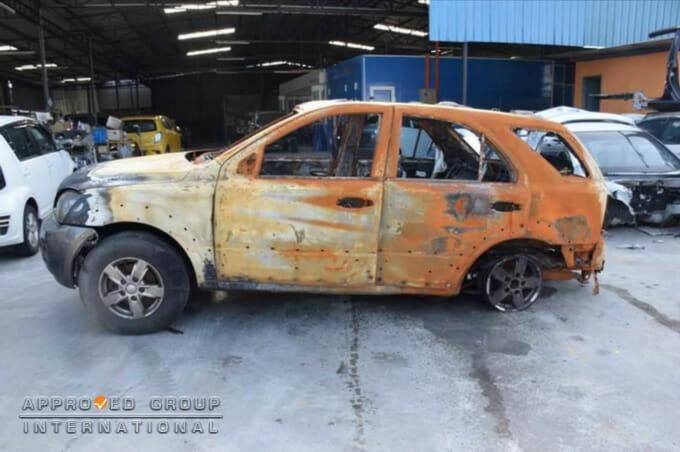
The VIN is usually stamped into the chassis of the vehicle; however, the location of the VIN differs for different types of vehicle. In many instances, criminals will obliterate the VINs by grinding so that ownership may not be traced. VIN verification is conducted by using a standard forensic technique known as chemical etching. When a VIN is stamped into the chassis, the metal beneath these stamp is compressed. By grinding away these characters may produce a smooth surface; sometimes, the perpetrator may re-stamp a new VIN to avoid suspicious. The theory behind chemical etching is that when an etching reagent is applied, the metal around the stamped characters will be etched away by the acid, leaving the compressed metal intact, hence revealing the original characters. In 2017, the Team was asked to verify the VIN of a vehicle that had caught on fire.
The VIN was stamped on two (2) different locations on the vehicle; the first location is on the nearside core support plate (hereinafter known as L1) made of steel and the second location is on the rear of the offside chassis frame adjacent to the wheel house (hereinafter known as L2) of the vehicle. The VIN consist of seventeen (17) alphanumeric characters. The letters and numbers are eight millimeters (8 mm) high with a consistent two millimeters (2 mm) gap between them. There were some abnormalities to the characters and alignment of the VIN on both locations. Comparisons were made between the VIN stamped on the vehicle with three (3) standard VINs from similar model of the vehicle. Based on the comparison, the Team found that there are some abnormalities and inconsistencies on the numerical and alphabetical characters stamped on the vehicle. The comparisons are as follows:
1There was a short vertical stroke (serif) seen at the beginning of the horizontal stroke of the numerical block.
2The final long slanting stroke of this numerical block was seen to be slightly curved.
3No short vertical stroke (serif) before the horizontal stroke of the numerical block seen.
4The final long slanting stroke was seen to be linear rather than curved.
5Two (2) strokes, started with curve at the left and then reversed L-line with extended vertical serif at the right.
6Two (2) strokes, started with curve at the left and then reversed L-line with extended vertical serif at the right.
7Continuous stroke with no extended vertical serif at the right.
8A slightly straight portion at the right side of the bottom curved stroke was seen.
9A smooth, curved stroke was seen at the bottom portion.
An insurance claim involving the similar model revealed that there was a total loss claim with another insurance 2012. Further enquiry and examination of the photographs for the 2012 claim revealed that the VIN at the L2 location is inconsistent with that of observed at the L2 location of the vehicle. The comparison are as follows:
VIN Recorded in 2012 total loss claim VIN Recorded in 2017 loss claim
Inconsistent characters at 9th, 10th, 11th, 15th,16th and 17th position.
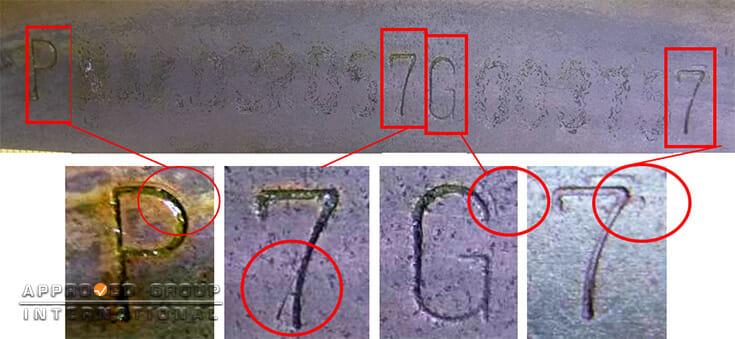
Therefore, based on the difference in characters, the VIN at the L2 location of the vehicle had been tampered with. Chemical etching was conducted on both L1 and L2 locations where the VIN were stamped. At the L1 position, after eleven (11) cycles, there were no hidden numbers or letters (ghost marks) revealed behind the originally observed alphanumeric characters. Therefore, the VIN located at the L1 location had not been re-stamped. However, the nearside core support plate may have been dismantled and replaced with another plate that is stamped with a new VIN. At the L2 location, after eleven (11) cycles of the chemical etching, the VIN was found to have been tampered with due to the appearance of impression (ghost) marks underneath the stamped VIN. The impression marks observed were parts of the previous original alphanumeric characters.
1A curved impression was seen above the curved stroke of the letter ‘P’. Likely letter: ‘P’
2There is a straight, slanted impression at the slanting stroke of number ‘7’. Likely number: ‘7’
3A curved impression was seen above the curved stroke of the letter ‘G’. Likely letter: ‘G’ or ‘C’, more likely ‘G’
4A horizontal impression was seen above the horizontal stroke of number ‘7’. Likely number: ‘5’ or ‘7’
The partially seen impression marks could not be visualized clearly/completely as the altered VIN was directly re-stamped on top of the original VIN. Thus, the remaining traces of the numerical and letter strokes were overlapped and concealed by the re-stamped VIN. Any further cycles of chemical etching would produce similar outcomes. Further etching cycles applied on the VIN may also obliterate the re-stamped VIN together with the impression marks observed since the chemical may erode the steel surface down to the deepest depth of the impression. Based on the physical examination and chemical etching, the VIN at the L2 location was tampered with, whereas the VIN at the L1 location shows no sign of re-stamping. The alignment and several characters on the VIN at the L1 location were found to be inconsistent with the acquired standard reference VINs.
A discipline in forensic sciences which concerns in evaluating documents which are disputed in the legal system. The main goal of forensic questioned document…
The operator of a Tower Crane was using it to lift up an object from the floor ground to the operator’s cabin. He noticed that the boom had deformed at the…
By AGI Team··2 min read
Read the article
24/7 response
Does this affect a claim you are handling?
Send us the detail and we will tell you what a proper investigation would need to establish.