

Approved Group International
Beachfront resort with an infinity pool, thatched pavilions and palm trees

Property

Hospitality and Leisure

Approved Group International investigates, assesses and restores losses in hotels, resorts, casinos, theme parks and the food and beverage operations that sit inside them.

Property

What we are called to in hospitality and leisure

Fire, failure investigation, damage assessment, restoration and risk assessment for hospitality and leisure operations, by the engineers who investigate the losses.

  • Hospitality and Leisure: what fails and why

What Fails in Hospitality and Leisure

The failures repeat across the sector. The pattern is worth naming. Domestic and chilled water risers corrode, are overpressured, or are damaged during unrelated works, and a burst several floors up finds every path downward, through risers, lift shafts and voids, before staff locate the source. Kitchen and laundry plant runs long hours under heavy load. Extraction ductwork carries grease that a fire, once started, uses as fuel. Back-of-house switchrooms sit in corridors guests never see. That is exactly why a fault there can run for some time before anyone notices.

Escalators and lifts fail mechanically and electrically. In a resort or casino they are often the only route between floors carrying real guest volume. A failure has consequences beyond the machine. Lightning and power surge reach lift controllers, laundry equipment and building systems through the same electrical infrastructure they depend on, and the damage is not always visible at the point of entry. Pool and spa plant, generators, and building management systems round out the list. None of this is dramatic on its own. What makes hospitality distinct is how fast a contained failure becomes a property-wide one.
Fire and Explosion

Commercial kitchens are the most frequent source of fire in this sector, usually through grease accumulation in ductwork, equipment left running unattended, or a fryer or griddle fault. Laundry dryers ignite the same way, through lint. Electrical fires originate in switchrooms, in plant, and occasionally in guest room wiring or appliances. The investigation has to establish whether the fire started in the equipment, the installation, or something brought into the room. We apply the method set out in NFPA 921. The scene is examined before it is disturbed. Fire spread is mapped through structure and ductwork. Physical evidence is tested against every plausible ignition source, not the first one suggested.

Explosion is rarer here. It usually involves gas supply to a kitchen, a boiler, or fuel stored on site. The questions are the ones that apply anywhere. What accumulated. What ignited it. What allowed the two to meet.

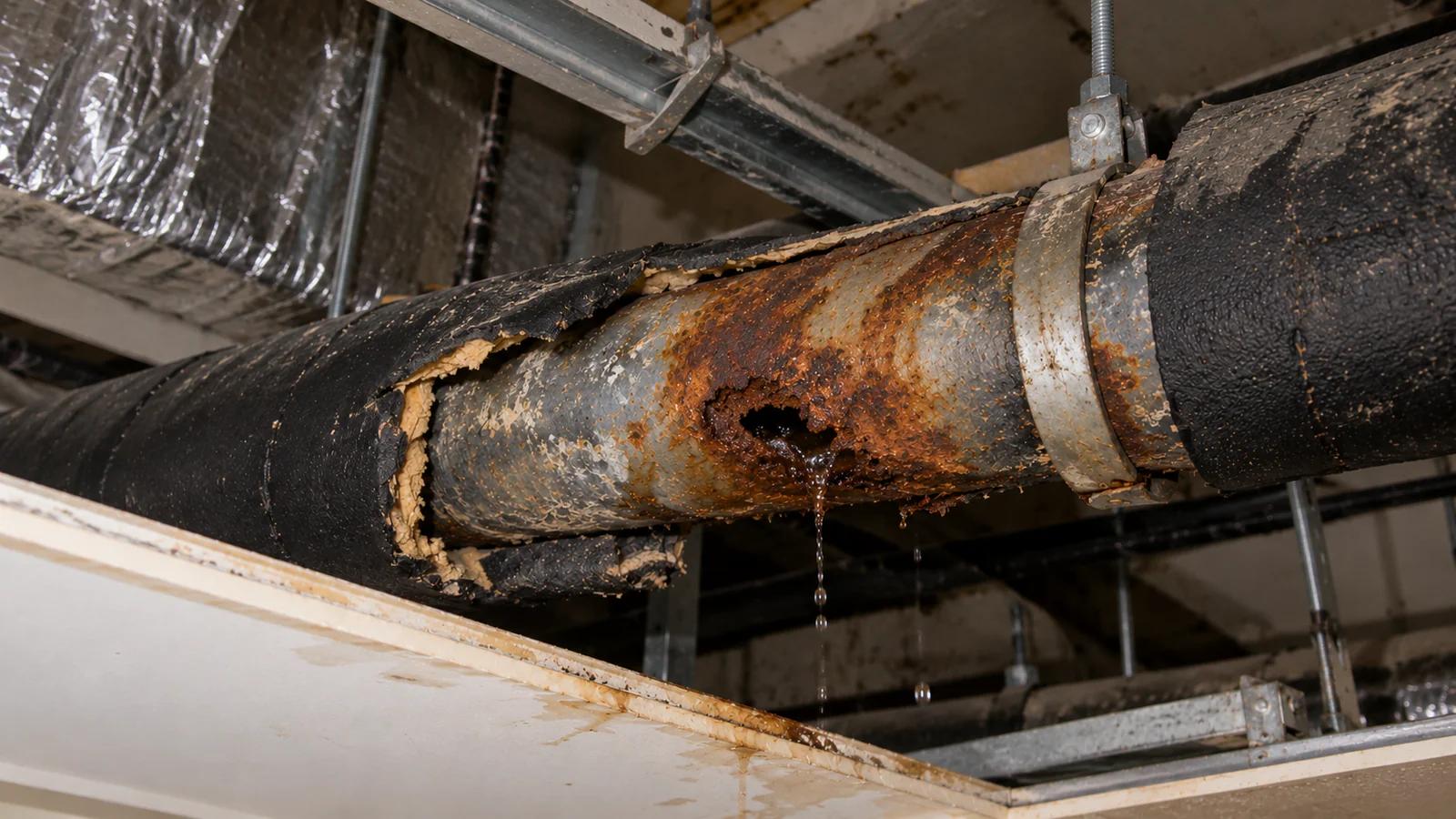
Corroded chilled water pipe dripping through a hole in a hotel ceiling void
Plate 01Corroded chilled water pipe dripping through a hole in a hotel ceiling void

Failure Investigation

A lift that fails. A chiller that trips offline during a heatwave. A generator that will not start when mains power is lost. Each is an engineering question with a specific answer, and the answer usually decides who bears the cost. Mechanical investigation covers motors, drives, compressors and rotating plant, and electrical investigation covers switchgear, distribution boards, and the protection meant to stop a fault becoming a fire. We establish what failed, how it failed, and what combination of design, installation, maintenance or operating conditions led to it. A maintenance contract that was not followed produces a different finding than a component that was defective from installation. Where the evidence does not permit a reliable determination, that limitation is stated.

Damage Assessment and Restoration

A damage assessment determines the nature and extent of the damage and the appropriate repair, restoration or replacement scope, and restoration begins once the relevant evidence has been documented, preserved or formally released for work. Restoration speed decides the business interruption loss here more often than the extent of the material damage does. A property with rooms out of service loses revenue on every one of them, every night. The gap between a slow reinstatement and a fast one is usually measured in weeks of trading, not in the repair invoice. Guest rooms need structural drying quickly, before mould takes hold behind finishes that look dry on the surface. Carpet, soft furnishings and joinery are assessed room by room. What can be cleaned, and what must be replaced, by people who understand what the fire, smoke or water actually did, not by a salvage rule applied uniformly. Kitchen equipment contaminated by smoke or firefighting water is decontaminated or replaced against the manufacturer's own tolerances, and where a property can reopen in phases, the plan is usually built around returning revenue-generating rooms to service first.

Risk Assessment

Before a loss, the same discipline identifies what is likely to fail. Riser condition matters. So does switchroom condition, kitchen suppression coverage, compartmentation between guest floors, and the condition of lift and escalator estates. These recur most often in pre-loss surveys of hotels and resorts. Multi-property groups usually want this delivered in one consistent format across the portfolio, so that a finding at one property can be checked against the same finding at another, and so that a board reviewing risk across twenty properties is reading one methodology rather than twenty different ones.

The Work in This Sector

We investigate. Fire and explosion investigation covers kitchen, laundry and switchroom origins, extending to gas and fuel-fired plant. Electrical failure investigation covers transformers, bus duct, low-voltage switchgear and the distribution feeding guest floors, while mechanical investigation covers lifts, escalators, chillers and generators. Where an incident involves an injury or a contamination complaint rather than property damage alone, the same evidential approach can reconstruct what occurred and establish contributing factors. Digital forensic investigation can support an incident affecting booking, keycard or point-of-sale systems.

We assess. Damage assessment covers lifts, escalators, laundry and kitchen equipment, carpets and soft furnishings, and building management and IT systems, room by room and system by system. Where a loss affects trading, the assessment extends to the specific rooms, outlets or facilities taken out of service and the period each was unavailable.

We restore. Restoration includes structural drying, carpet and soft furnishing restoration, and decontamination of kitchen and laundry equipment against manufacturer tolerances. Contents can be restored off site where a room or outlet must be cleared quickly, and architectural surfaces, metal, stone, timber and glass, refinished rather than replaced where the damage allows it. Document and guest-record recovery sit within the same practice, phased so a property can reopen area by area rather than waiting for the whole building.

We survey before a loss. Pre-loss review covers riser and switchroom condition, kitchen suppression coverage, and the lift and escalator estate across a single property or a portfolio. It extends to leak detection coverage, extreme-weather exposure, and building and equipment inspection programmes that a multi-property group can apply consistently across its portfolio.

What Decides These Cases

A small number of questions decide most losses here. One event, or a condition developing for months. That distinction changes how the loss is characterised. How business interruption is measured, for a property that never fully closes but lost a defined number of rooms for a defined number of nights, has to be built from the property's own occupancy and rate data, not from an assumed average across the portfolio or the market. And liability between the operator, the management company and the contractor responsible for the failed system is, more often than the cause itself, the question actually in dispute.

Common questions

Working in hospitality and leisure

24/7 response

A loss in hospitality and leisure?

Tell us what failed. You will get an engineer who has seen it in this sector, not a general enquiry form.