
Approved Group International
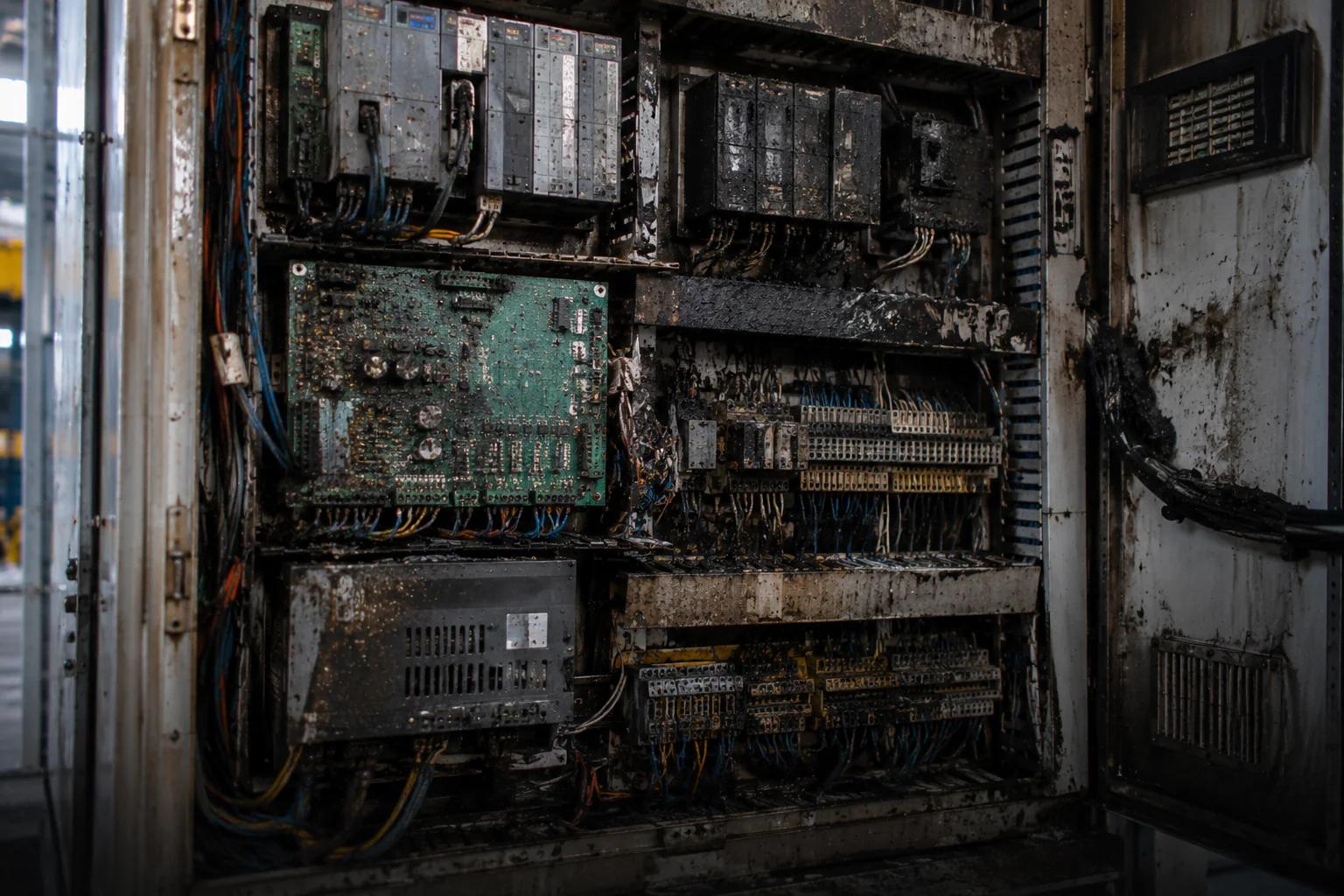
Open control cabinet with soot and water damage on its circuit boards and wiring

Forensic Investigation

Electronic Failure Investigation

Electronic failure investigation establishes why a board, a component or a system stopped working, once a fault, a contaminant or an event had already reached it.

When to call

  • When a production line or a control system has stopped, and electronics are suspected.
  • Liability and recovery against a supplier or contractor.
  • Where a dispute over damaged electronics needs an independent finding.
  • After an industrial incident that has not yet become a formal dispute.
  • Pre-loss.

What you receive

  • AGI may be instructed by any party requiring an independent electronic failure investigation.
  • Preliminary advice is usually available within days of examination, so that decisions on replacement or repair need not wait for the full report.
  • Major electronic systems routinely cross borders: manufactured in one country, installed in another, and contracted or financed from a further…
  • The engineers who examine boards and systems are chartered or professionally registered where they practise.
  • We also share what this work teaches.

What Is Electronic Failure Investigation?

It asks a narrower question than an electrical failure investigation. Electrical Failure Investigation covers switchgear, transformers, cabling and distribution at system level; it does not ask why a specific board or instrument failed once a fault, a contaminant or an event had already reached it. This discipline picks up at that point. The question becomes which component failed, by what mechanism, and whether the physical evidence supports the account given of events.

That distinction matters in practice. A distribution board that tripped correctly on a fault is a system working as designed. A control card behind it that failed is a separate question, with its own cause and its own evidence.

This is not a damage assessment, which determines the nature and extent of damage and the appropriate repair, restoration or replacement scope. Electronic failure investigation addresses why the failure occurred and what that means for restorability, not what it costs to put right.
How We Investigate

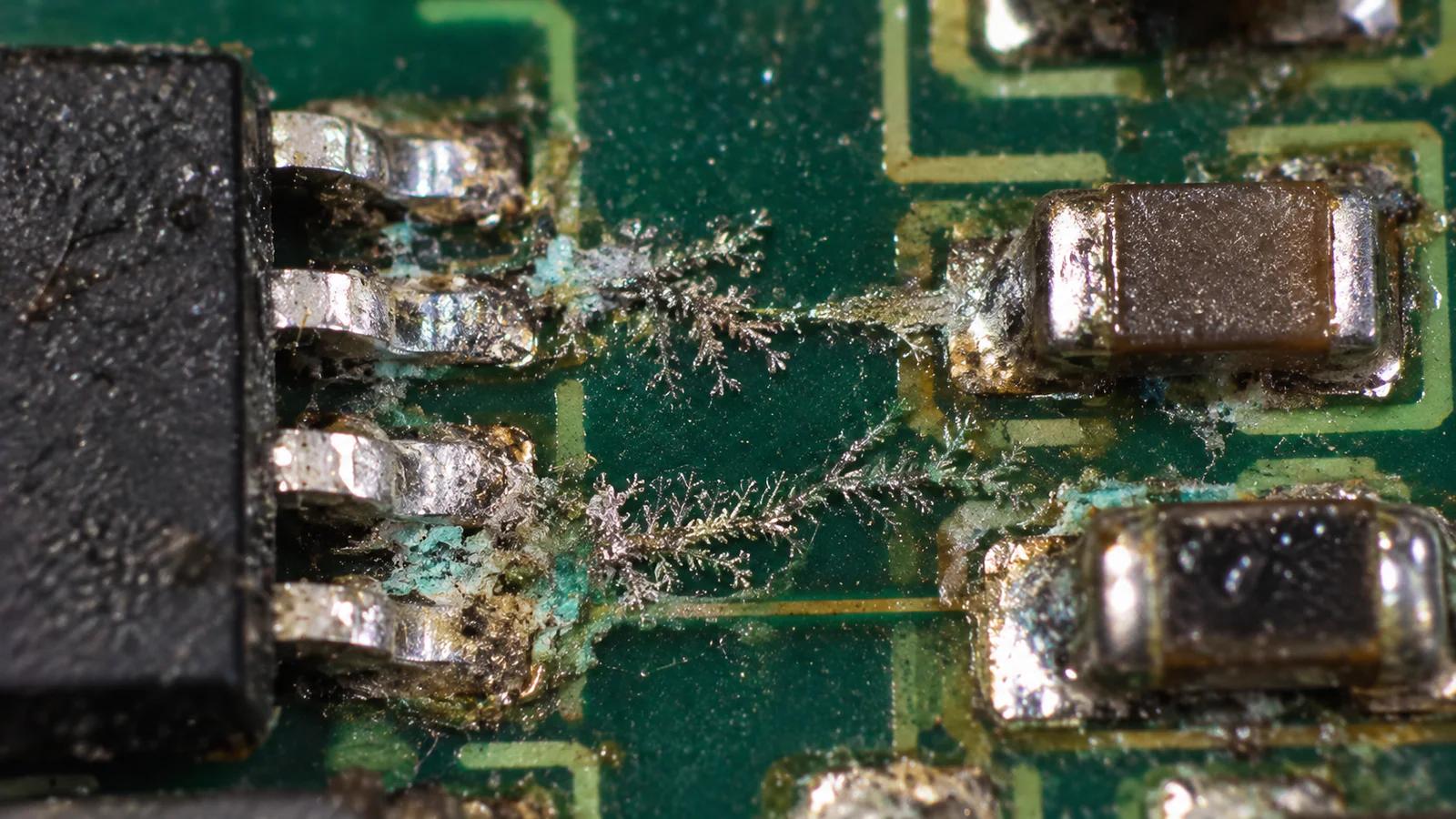
Visual and microscopic examination. Every board and component is examined and photographed at macro and microscopic level. Burn marks, corrosion tracking, dendrite growth and physical damage are mapped against the circuit's own layout before anything is disturbed.

Contamination chemistry. Where soot, moisture or a corrosive residue is suspected, ion chromatography, gas chromatography-mass spectrometry and scanning electron microscopy are applied to identify what the contaminant is and whether it explains the pattern of failure observed.

Dendrite growth and IPC testing. Cleaned boards are tested against IPC test methods to determine whether a contamination mechanism is still active and will continue to degrade the board, or has already run its course.

Functional and swap testing. Recovered boards and units are powered up, load-tested or swapped against a known-good reference of the same design, separating what still functions from what does not.

Power-quality and protection records. Surge counters, protection-relay data and power-quality logs are reviewed wherever a transient or a surge forms part of the account, alongside the condition of earthing and bonding.

Event-timeline comparison. The sequence of what failed is checked against the date, time and mechanism the loss is said to have followed, including whether the damage sits upstream or downstream of the point a surge or an event is said to have entered the circuit.

Report, and defend where needed. Findings are set out as cause, restorability and consistency with the account given of the loss, with expert evidence available where the matter proceeds to arbitration, litigation or another formal hearing.

Close-up of corrosion and dendrite growth between components on a circuit board
Plate 01Close-up of corrosion and dendrite growth between components on a circuit board

What We Investigate

Control cards and printed circuit boards. Populated boards, processor and relay cards, and the control cards inside larger equipment, examined for corrosion, thermal damage, component-level failure and contamination.

Programmable logic controllers and supervisory control systems. The controllers and supervisory systems that run production lines, utilities and building services, investigated where a fault has stopped or misdirected a process rather than simply tripped it.

Servers, network hardware and data hall estates. Server hardware, networking equipment and the racks that hold them, investigated after flood, fire, a power event or a cooling failure affecting a data hall or comms room.

Laboratory and analytical instruments. Chromatography and spectrometry equipment among them, where the instrument itself is the damaged asset rather than the tool used to examine something else.

Medical imaging and treatment systems. Imaging and treatment equipment where downtime and replacement cost make an independent finding on cause and restorability material to the decision facing the hospital. A unit cannot usually be swapped for a new one while that finding is pending.

Large displays. Driver boards, power supplies and panels behind large-format displays and signage installations, following water ingress, a power event or physical damage.

Semiconductor process and handling tools. Process and handling equipment used in wafer fabrication and electronics manufacture, where a single tool failure can carry a production value disproportionate to the unit itself.

Lift and escalator controllers and drives. Controller panels, drive units and their control cards, a recurring source of investigations following water ingress, power events and lightning.

What Decides These Cases

Power event, contamination, water, surge or internal defect. These mechanisms leave different physical signatures on a board, and mistaking one for another changes what the finding can support and who may be responsible.

Whether the contamination is still active. A board carrying corrosive residue that will keep spreading needs replacing. A board where the same residue has already run its course, cleaned and tested clear, can usually return to service. Dendrite growth testing is how that distinction is made rather than assumed, and a finding on restorability is bounded by what testing can observe on the day it is carried out.

Whether the damage is consistent with the event timeline. A board said to have failed in a single incident can sometimes show a failure pattern that has clearly developed over months, and the two accounts are not compatible. Establishing which is the case is often what separates a supportable finding from a disputed one.

Whether a surge could physically have reached the damage. The damage pattern must be consistent with a technically credible path from where the surge or the event is said to have entered the circuit to where the damage was found. Where it is not, alternative causes are considered, whatever the initial account of the loss assumed.

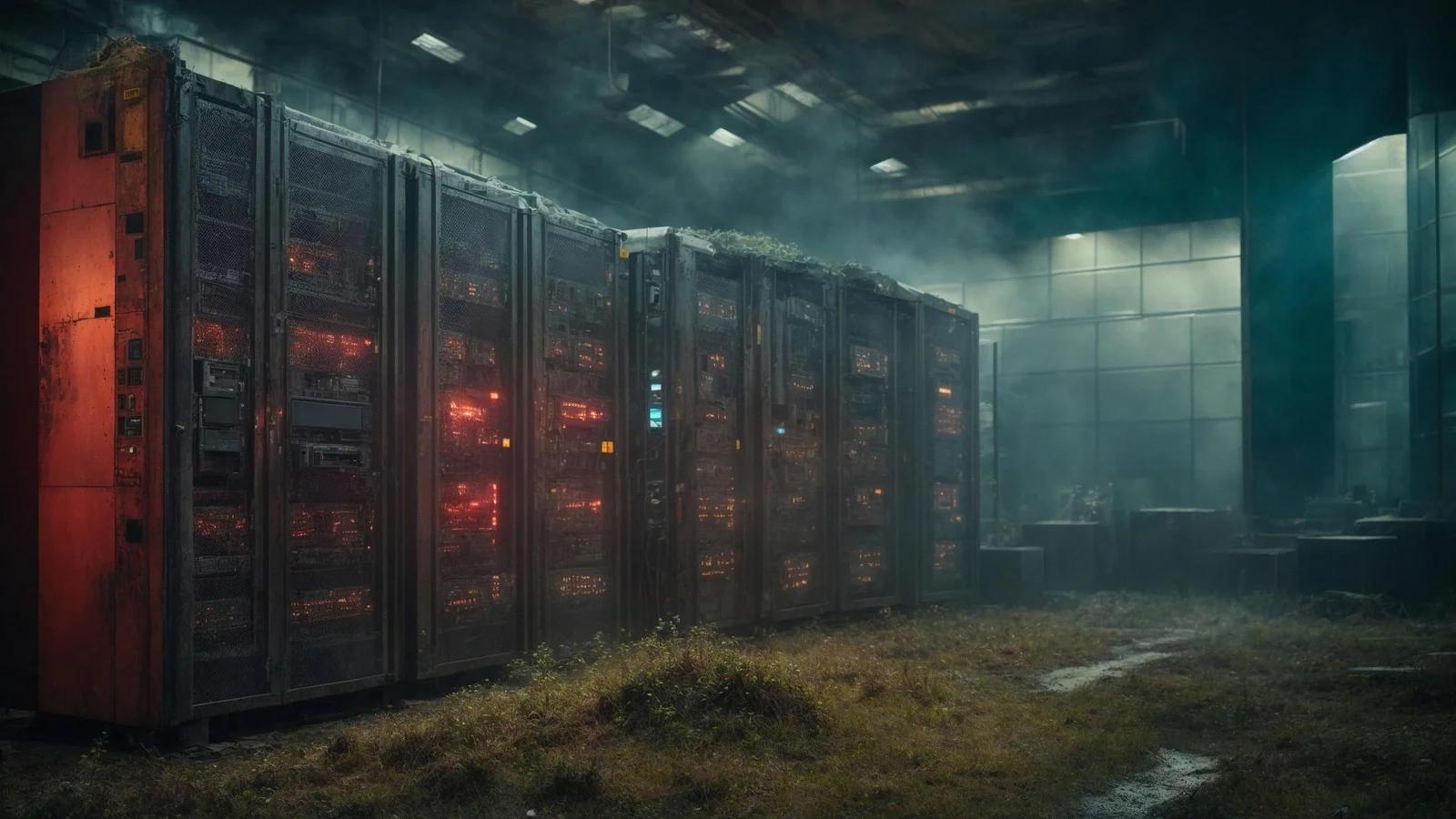
Server racks in a dim, contaminated data hall after a cooling failure
Plate 02Server racks in a dim, contaminated data hall after a cooling failure

Common questions

About electronic failure investigation

The questions that come up before an instruction, answered plainly.

24/7 response

Protect the evidence first

Restrict access, change nothing, and call. Most of what decides a case is still on site in the first few days.

Emergency line open at all hours, across every office.